
£160k annual income | 2,300 monthly players acquired | 80% below target CPA
Dementia UK tested paid social for lottery acquisition with no established benchmarks. We created multi-variant campaigns with custom tracking, testing messaging and audience targeting. The results were £160k annual income and 2,300 monthly players at 80% below the target CPA.
The charity supports families living with dementia by providing Admiral Nurses, experts in dementia care who give the practical and emotional support that families need. We’ve worked with the charity for seven years across fundraising, brand, and new product development.
Their Weekly Lottery launched in 2023 as a new regular income stream. With organic social and email bringing in early players, the question was whether paid advertising could acquire new members efficiently enough to make the channel financially viable and if so, how far it could scale.
A new lottery product with no paid acquisition benchmarks
When we took on the pilot campaign, Dementia UK had no paid social benchmarks for lottery acquisition. Players were coming through organic and email, but the team needed to know whether paid media could deliver new players at a sustainable cost before committing to it as a long-term channel.
The initial target was deliberately cautious, reflecting the reality that lottery players can be expensive to acquire in a crowded market. Should the first phase be successful, the insights it generated could help to inform the shape of future paid activity.
Starting with competitor research and 14 creative variants
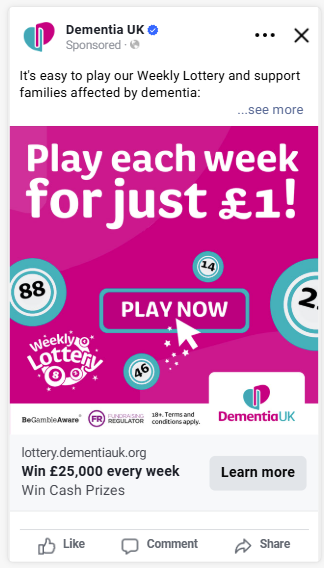
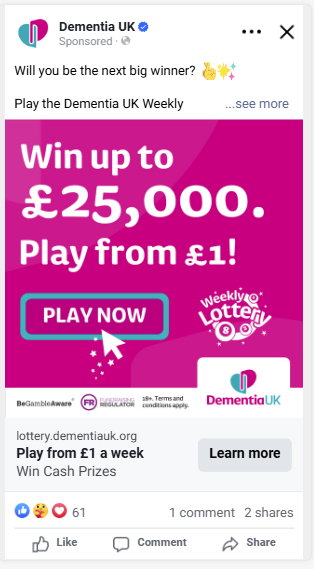
We started with detailed competitor research that informed a creative build of multiple ad copy variants and images, all developed within gambling and lottery advertising standards.
The campaign was designed to test as well as acquire. We ran prize-focused messaging against cause-focused messaging, and graphic formats against images with text overlays. We tested broad audiences against specific lottery and cause interests, and built retargeting ads for users in the consideration phase who hadn’t yet converted.
On the technical side, we set up custom event tracking to pull conversion value directly through the Meta pixel, and used live data from the lottery platform back-end to provide a single source of truth for reporting. This eliminated the distortion caused by cookie blocking, which is a constant challenge in charity digital campaigns.
£160k annual income and 2,300 monthly players acquired
With the pilot results in hand, Dementia UK asked us to run a second phase, this time testing whether the campaign was sustainable over longer timescales and higher spend. We managed to make the CPA fall further again.
We’ve now run two phases per year since, scaling either media budget or campaign duration with each cycle.
Across six phases of activity, the lottery has generated over £160,000 of annual income, with over 2,300 monthly players acquired through paid social.
Moving to always-on acquisition
Having proved that paid media can deliver lottery players at efficient CPAs across multiple phases and budget levels, the next challenge is sustaining that performance year-round.
In Phase 7 we’re testing new platforms, managing creative pipeline in response to Meta’s Andromeda update, and running lottery activity across ten months of the year with an eye towards always-on delivery from next year.
“Our paid lottery activity continues to be an effective, valuable product in our Individual Giving programme, exceeding our expectations,” said Eirnin Jefford Franks, Senior Individual Giving Executive at Dementia UK.
“Platypus have consistently enabled us to run this campaign with the support of their expert insights, scaling up successfully at every phase.”
Find out how we can grow your lottery product
If you’re running or considering a charity lottery and want to understand whether paid social can make acquisition work, find out more about our Meta Ads service for charities, or get in touch.