As AI platforms are evolving into the primary way people discover information online, the definition of search visibility is changing. It’s no longer just about ranking on the first page of traditional search results, it’s increasingly about being cited as a trusted source in AI generated answers.
However, until recently, tracking this visibility has been a major challenge. We’ve largely been flying blind, forced to rely on third party estimate data, manual testing, or educated guesses to figure out if and where our content is being surfaced by AI.
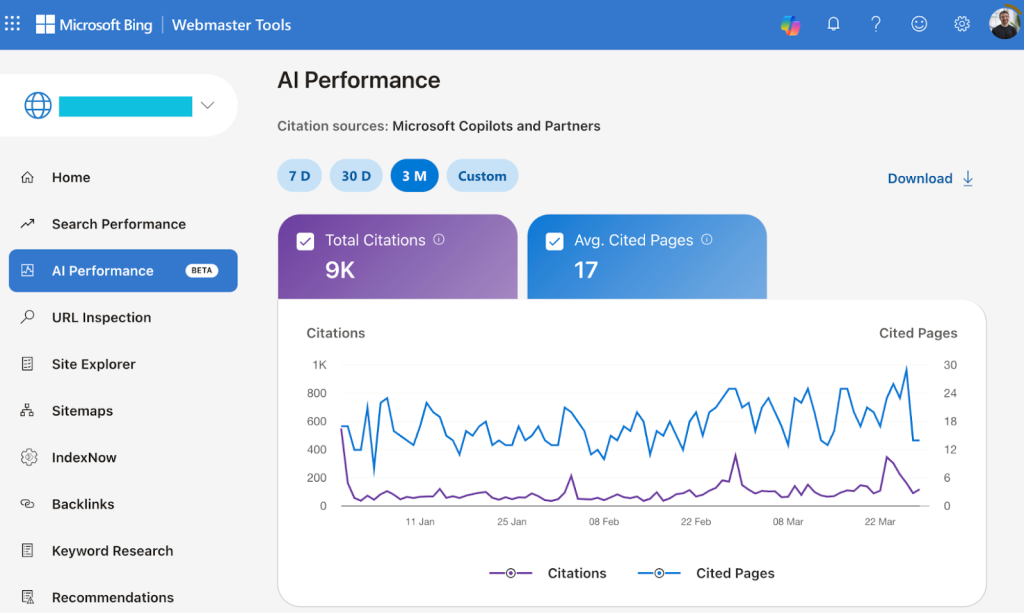
Microsoft has just rolled out a game changing update for Bing Webmaster Tools, the AI Performance Dashboard. For the first time, website owners have access to first-party data revealing exactly how their brand appears across the AI web.
Here is a breakdown of what this update means, and how you can start using it today.
Bing’s AI Performance Dashboard
The new dashboard in Bing Webmaster Tools (Microsoft’s equivalent to Google Search Console) provides a direct look into how your content interacts with Microsoft’s AI ecosystem.
To understand the value of this data, it’s helpful to understand Microsoft Copilot. Copilot is Microsoft’s dedicated AI assistant, powered by advanced Large Language Models (LLMs). It functions both as a standalone AI chatbot for Microsoft users, and is heavily integrated directly into Bing’s search engine to provide conversational, synthesized answers to user queries.
Like other LLM’s and AI search tools, when Copilot generates an answer, it uses a process called “grounding.” Grounding is the system that connects the AI to current, authoritative web content. Instead of just relying on its existing training data, the AI retrieves relevant live pages, references them, and cites them to provide accurate, up to date responses.
The new dashboard measures exactly how your site is used in this grounding process, offering several key metrics:
- Total Citations: A top-level view of how often your site’s content is referenced by AI systems, showing your overall footprint in AI answers.
- Page-level Citations: A breakdown of which specific URLs are cited most frequently, highlighting the exact pages the AI relies on.
- Grounding Queries: The specific keywords and phrases the AI used to retrieve your content.
- Grounding Query-to-Page Mapping: A new feature that lets you connect the dots, showing exactly which queries are driving citations to specific pages, and vice versa.
- Visibility Trends: Charts tracking how your citation activity changes over time.
What this means for your charity
The biggest win here isn’t just seeing a tally of total citations. We can finally start to move past traffic only measurement and start optimising for “AI visibility.”
By diving into this new data, you’ll be able to uncover high impact AI search optimisation opportunities:
- Reverse Engineer Top Pages: Identify which of your pages are cited most frequently. What do they have in common? Are they structured with clear headings? Do they use concise, direct language? You can use these insights to create guidelines for optimising the rest of your site’s content.
- Rescue Underperforming Content: Look for pages that you know are indexed but have low (or zero) citations. These represent missed opportunities. You can update these pages to improve their clarity, structure, or comprehensiveness, making them easier for the AI to parse and confidently cite.
- Align with “AI Intent”: By looking at the Grounding Queries, you can see the exact context in which the AI thinks your content is relevant. If the AI is pulling your page for a query you hadn’t considered, you might find new angles to expand your content or entirely new topics to cover.
What you should do next
If you want to stay competitive in the current AI search landscape, you need visibility into how your content is being used.
If you already have a Bing Webmaster Tools account: We highly recommend logging in this week to explore the new AI Performance report. Look at your grounding queries and see which pages are currently leading your AI visibility.
If you don’t have a Bing Webmaster account set up: Now is the perfect time to do so. Setting up Bing Webmaster Tools is completely free and incredibly easy, you can follow their guide here. You can even seamlessly import your existing verified properties directly from Google Search Console.
A look to the future of search analytics
Microsoft has set a new standard for search analytics with this release. By opening up the black box of AI citations, they are giving webmasters the tools needed to adapt to the new era of search.
The big question now is how Google will respond. As Google continues to roll out AI Overviews in its own search results, the pressure is on for them to provide similar transparency. Hopefully, this development from Microsoft will act as the catalyst needed to encourage Google to add dedicated AI visibility tracking to Google Search Console and Google Analytics 4 (GA4) in the near future.
Until then, Bing Webmaster Tools might just be your best window into the AI web.
If you’d like to chat to us about AI search optimisations, or SEO more broadly, drop us a message!